Zircon, zirconium or zirconia? The journey from a mineral I photographed in London to the dental zirconia we use in a patient’s smile.
Years ago, while walking through a museum in London, I stopped in front of a mineral collection.
One specimen caught my attention, so I took a photograph.
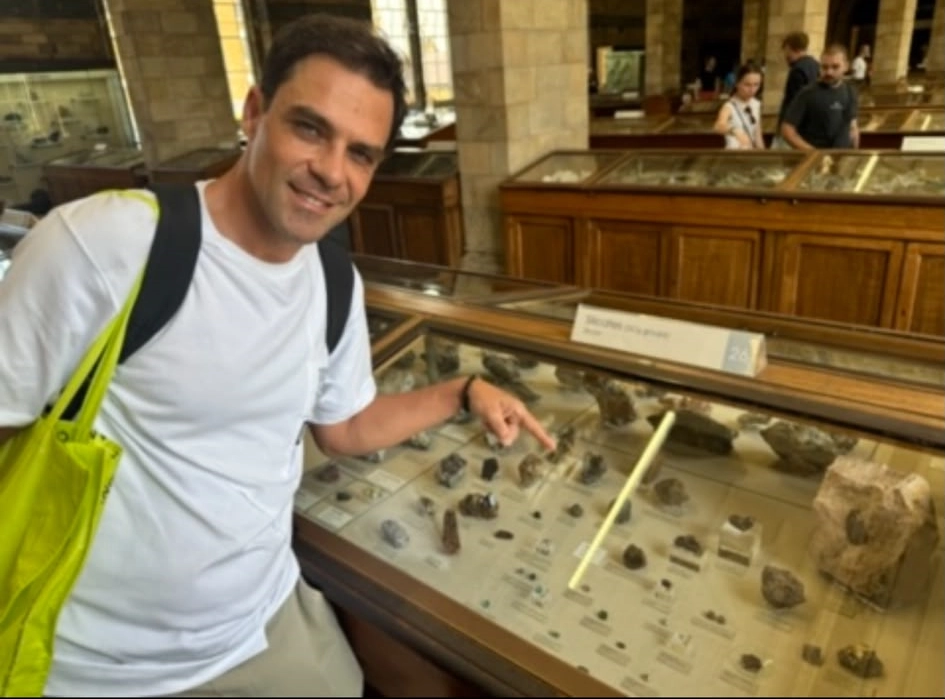
The label read:
Zircon — ZrSiO₄.
At the time, it was simply an interesting mineral.
Years later, that photograph means something different to me.
Because in my clinic, I have another image. This time, not of a mineral, but of a certificate for the dental zirconia material we use for restorations.
On one side, something formed in nature.
On the other, an engineered dental ceramic that may eventually become part of someone’s smile.
And between these two photographs lies a fascinating journey.
It also answers a question I often hear from international patients:
Is it zircon, zirconium or zirconia?
The words sound similar. Scientifically, they are not the same.
Zircon, zirconium or zirconia?
What I photographed in London was zircon.
Zircon is a naturally occurring mineral with the chemical formula ZrSiO₄ — zirconium silicate. It is an important natural source of zirconium.
Zirconium, on the other hand, is a chemical element. Its symbol is Zr, its atomic number is 40 and, in elemental form, it is a metal.
Then we have zirconia.
Zirconia is zirconium dioxide — ZrO₂. It is a ceramic, and this is the material family that matters to us in restorative dentistry.
So when a patient says, “I want zirconium teeth,” I understand exactly what they mean. It has become a commonly used expression.
Scientifically, however, what we normally place is a zirconia crown, bridge or dental restoration.
We are not cutting the zircon stone in my photograph into the shape of a tooth.
The journey is much more sophisticated than that.
From a mineral to a dental material
Through industrial and chemical processes, zirconium can ultimately be processed into highly purified zirconium dioxide.
But dental zirconia is more than simply purified material.
It is an engineered ceramic whose composition, crystal structure and manufacturing process are carefully controlled to produce properties suitable for dentistry.
Somewhere along this journey, geology becomes chemistry.
Chemistry becomes material science.
And material science eventually becomes dentistry.
Before zirconia looks anything like a tooth, it may reach the dental laboratory as a zirconia disc or blank.
This brings me to my second photograph.
The certificate belongs to an original Amann Girrbach Zolid Gen-X dental zirconia blank and provides product, production and traceability information.
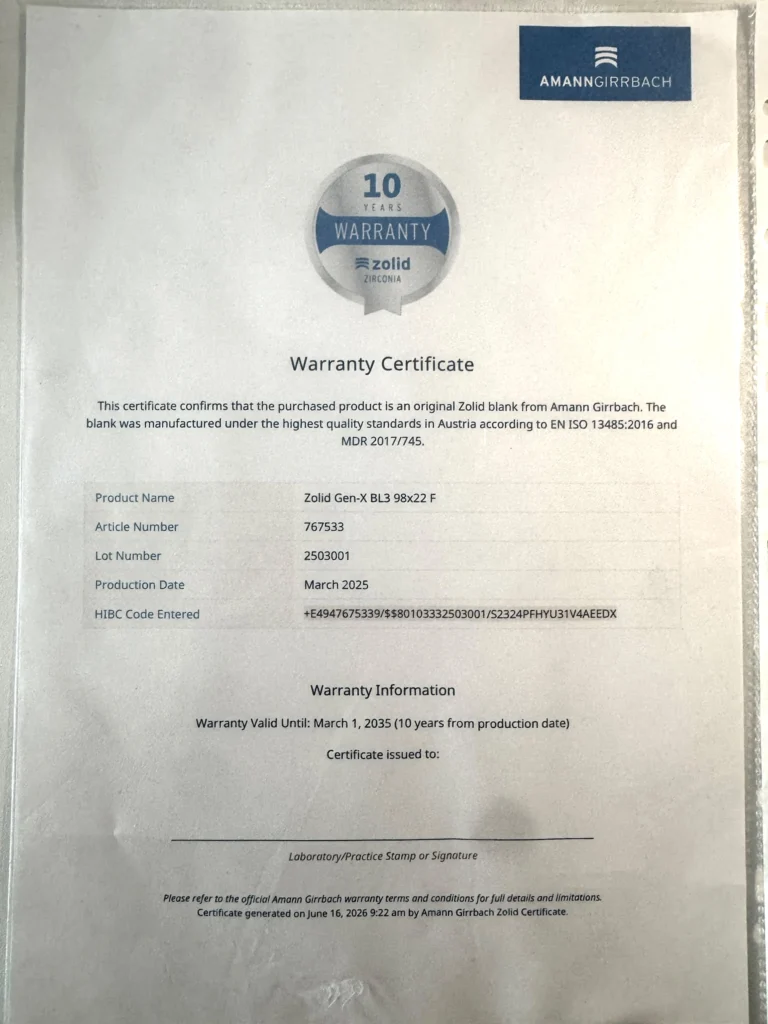
I keep documents like this for a simple reason:
I want to know what material I am putting into a patient’s mouth.
But the certificate is still only one part of the story.
From a zirconia disc to a tooth
The zirconia disc does not know whether it will become a front tooth, a molar or part of a bridge.
That requires dentistry.
Using a digital workflow, we collect the necessary clinical information, evaluate the preparation and bite, design the restoration and mill it from the selected zirconia blank.
The milled restoration then undergoes sintering, a carefully controlled high-temperature process. Depending on the case and material, further characterisation, glazing and polishing may follow.
Only then does it begin to look like what the patient recognises as a tooth.
The journey is remarkable when you put it in order:
Zircon → Zirconium → Zirconia → Dental zirconia → Digital design → Milling → Sintering → Restoration → Patient.
There is a surprising amount of science between a mineral and a smile.
Not all zirconia is the same
This is probably more important clinically than what we call it.
Zirconia is not one single material.
Modern dental zirconias have different compositions and properties. Some prioritise mechanical strength; others offer greater translucency for aesthetic applications.
This means my question is not simply:
“Is zirconia good?”
I prefer to ask:
Which zirconia? For which tooth? For which patient? And why?
That is a much more useful clinical question.
A certificate cannot make a clinical decision
Material traceability matters to me. Knowing the manufacturer and the specific dental material being used matters too.
But a certificate cannot guarantee a good restoration.
The diagnosis matters.
The preparation and digital scan matter.
The design, milling and sintering matter.
The laboratory work and occlusion matter.
And ultimately, the dentist’s clinical judgement matters.
I think of it this way:
The certificate can tell me where the material came from. It cannot tell me whether I made the right clinical decision.
The material cannot examine the patient, understand their expectations or decide whether it is appropriate for that particular situation.
That responsibility still belongs to us.
From zircon to a human smile
When I look at my photograph from London today, I no longer see only a mineral.
I see the beginning of a journey.
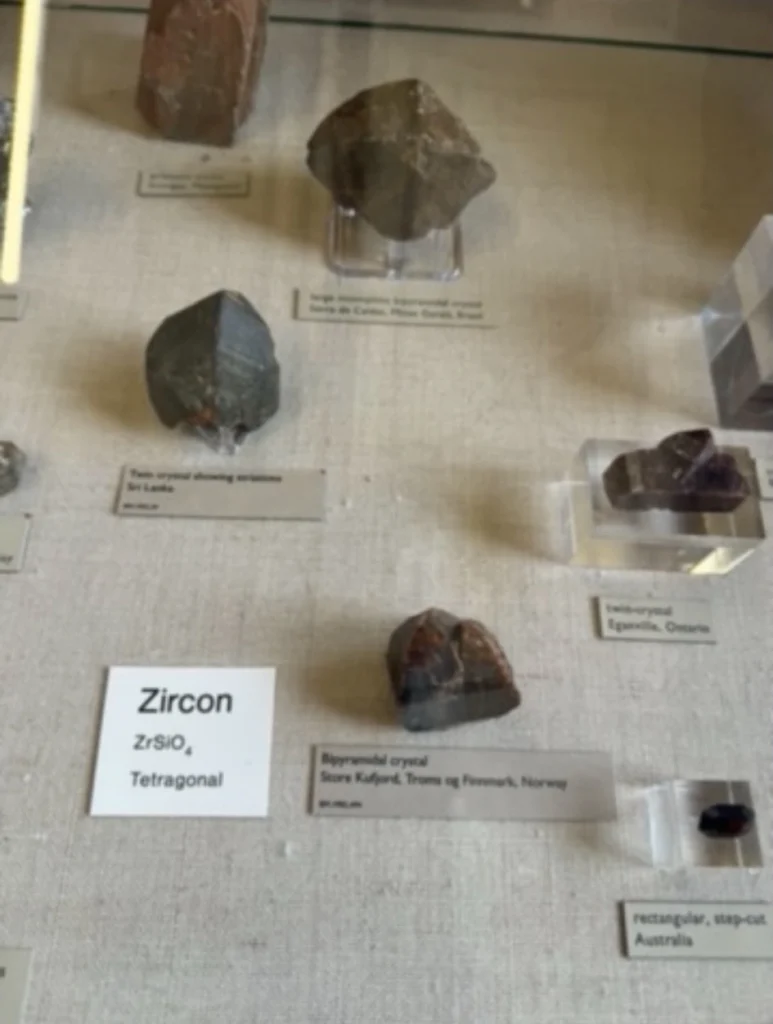
On one side is zircon — ZrSiO₄, formed by nature.
On the other is dental zirconia, engineered through chemistry, material science and technology.
And at the end of that journey is not simply a crown.
There is a person.
Someone will smile with it, eat with it and live with it.
That is why I do not want to choose a dental material simply because it is popular.
I prefer a different question:
What is the right material for this particular situation and this particular person?
I took that photograph in London because a mineral caught my attention.
I did not know that years later I would use it to explain dentistry.
The distance between that mineral and a patient’s smile is much greater than a change of name.
It is a journey through nature, chemistry, engineering, digital dentistry and clinical judgement.
And perhaps that is why I still enjoy asking where the materials I use every day actually come from.
Because sometimes, to understand a tooth, you have to start long before it looks like a tooth.